The World Wide Web has become an essential modern tool for people’s daily routine. The fact that it is a convenient means for communication and information search has made it extremely popular. This fact led companies to start using online advertising by creating corporate websites. With the rapid increase in the number of websites, search engines had to come up with a solution of algorithms and programs to qualify the results of a search and provide the users with relevant content to their search. On the other side, developers, in pursuit of the highest rankings in the search engine result pages (SERPs), began to study and observe how search engines work and which factors contribute to higher rankings.
The knowledge that has been extracted constituted the base for the creation of the profession of Search Engine Optimization (SEO). This paper consists of two parts. The first part aims to perform a literature review of the factors that affect the ranking of websites in the SERPs and to highlight the top factors that contribute to better ranking.
To achieve this goal, a collection and analysis of academic papers was conducted. According to our research, 24 website characteristics came up as factors affecting any website’s ranking, with the most references mentioning quality and quantity of backlinks, social media support, keyword in title tag, website structure, website size, loading time, domain age, and keyword density.
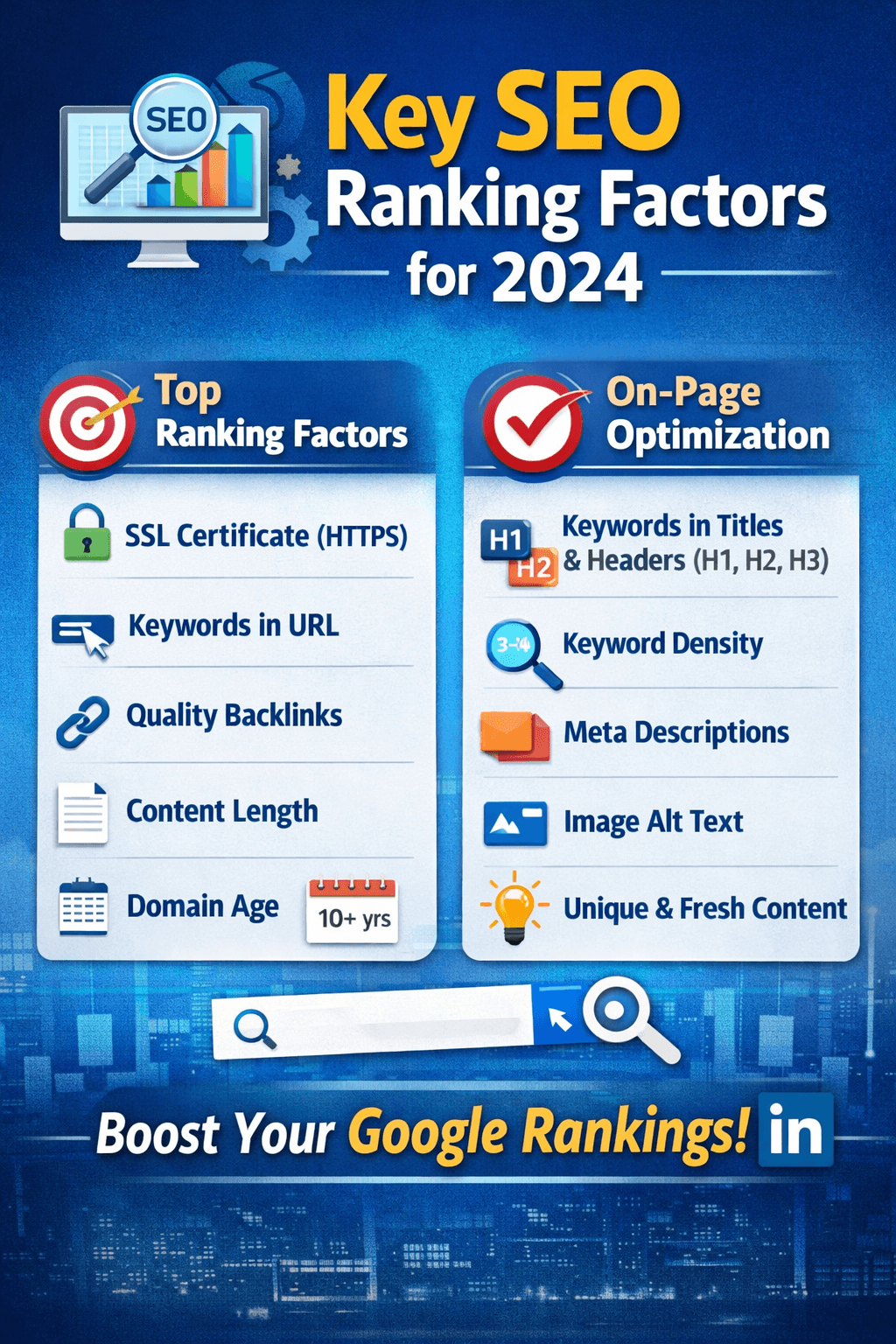
The second part consists of our research which was conducted manually using the phrases “hotel Athens”, “email marketing”, and “casual shoes”. For each one of these keywords, the first 15 Google results were examined considering the factors found in the literature review. For the measurement of the significance of each factor, the Spearman correlation was calculated and every factor was compared with the ranking of the results individually. The findings of the research showed us that the top factors that contribute to higher rankings are the existence of website SSL certificate as well as keyword in URL, the quantity of backlinks pointing to a website, the text length, and the domain age, which is not perfectly aligned with what the literature review showed us.
Keyword in h1/h2/h3 tag: Equally important on page intervention is the use of keywords in h1, h2, and h3 tags. This element is the second most important on page factor for higher ranking in the search results. The websites with optimized and targeted h1, h2, and h3 tags are ranked higher by the search engines. This happens as the crawler searches for information regarding the content structure of every website and the best way to extract this piece of information is to search on these tags. Skipping this part of optimization is a big obstacle on the way to higher ranking. Keyword density in text: The keyword density is the number of times the targeted keyword appears in the text of a website compared to the rest text. This on-page factor and the frequency of times the keyword appears in title tag are considered some of the most important factors when optimizing a website. The ideal keyword density range is 2 to 8% of the text of the page but this range is not universally true and is affected by other factors. We have to pinpoint that the keyword density should not have negative impact on the readability of the text because it is perceived as negative element of a website by the search engines Keyword in URL: It is easier for crawlers to trace a website if its URL contains the targeted keyword. In general, search engines tend to rank higher websites with .edu and .gov domains as these domains are used by state and educational websites. However, optimization for all types of websites can be achieved if the length of the URL is kept short. Keyword in meta description tag: The meta description tag is a summary of the content of a webpage. This tag contains the text that appears in the search results of the search engines just below the link. The meta description tag is a guide on what keywords should the website be indexed for by the search engines Alt text: To be ensured that the most elements of a website are indexed correctly, they have to be in HTML format. However, content such as images and videos need more information to be indexed by the search engines. Webmasters must use an alt tag for images and a transcript for videos to provide enough details about those types of content. Unique high-quality content: Search engines prefer websites with unique, authentic, and quality content. If the content of a website is plagiarized from another website it will not be ranked high by the search engines. In addition, a frequently updated content has better chance to get ranked higher in search engines for related keywords. Title length & Description length: The title of the website must reflect the topic of the website without unnecessary information. With the use of a short and comprehensive title, website visitors can understand the main topic of the website. Google suggests no more than 70 characters for title tag. The meta tag description offers some pieces of information in the search engines about the website. A poor or no description in this tag suggests a low-quality website. On the other side, larger than standard text (up to 155 characters recommended by Google) may be considered spam as the targeted keywords may be used excessively
explain it inn short